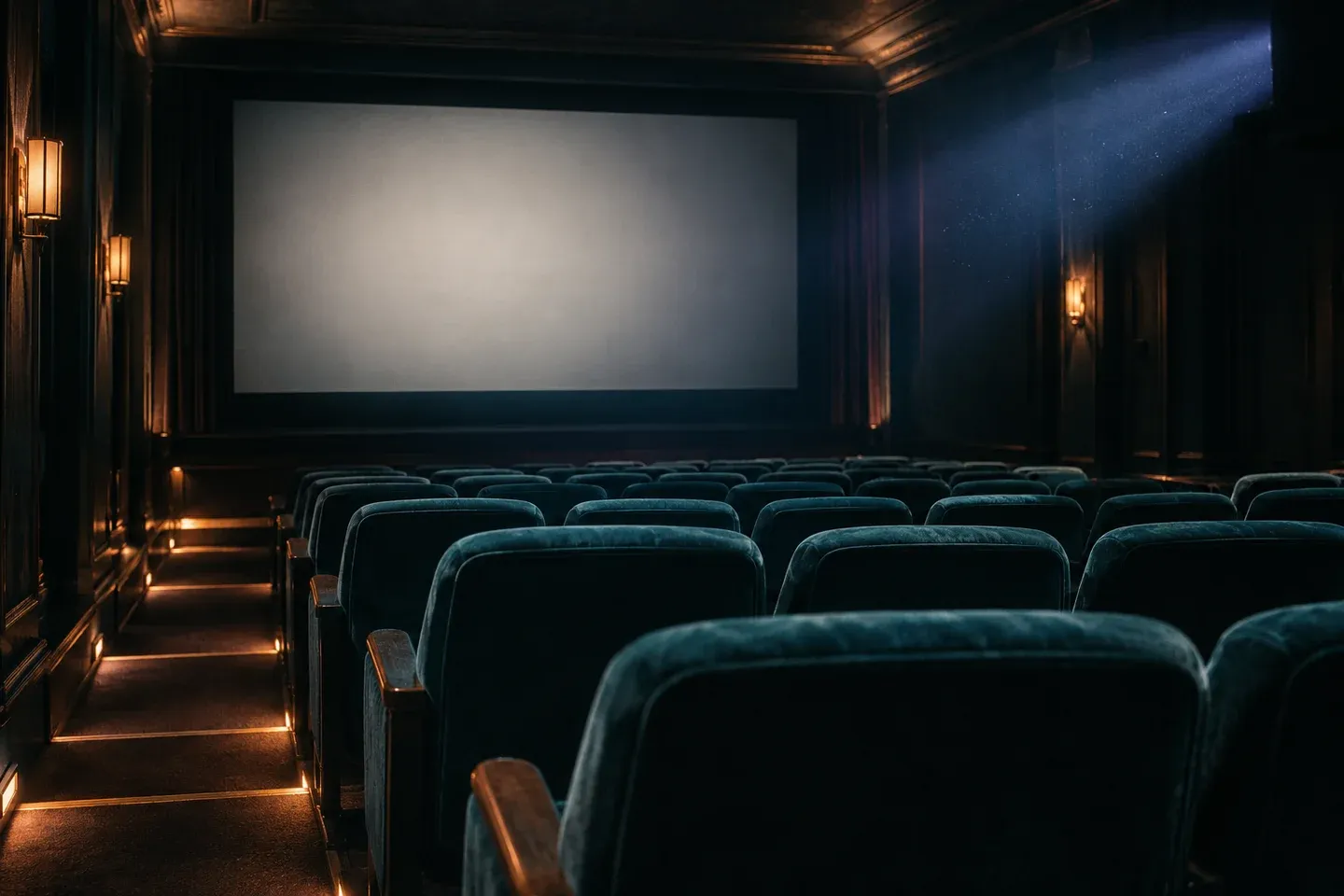
We may forget the plot and carry the atmosphere
A few days after a film, putting its events in the correct order can be surprisingly difficult. Yet the sound of a closing door, an empty room held on screen, or a single colour emerging from darkness may remain easy to recall. What remains after a film is sometimes an atmosphere rather than a synopsis. Here I approach that atmosphere through sound, colour and editing rhythm. The aim is not to turn every screening into an examination, but to find more precise words for something that moved us or made us uneasy.
There is nothing inadequate about saying a film was beautiful. Still, wondering what sits behind that response opens another way of watching. An image may direct our eyes while a sound draws attention somewhere else. A cut may suggest something a character never says. We do not need to claim professional expertise in editing or sound to notice these possibilities. Small, observable questions make a useful beginning: what did I see, what did I hear, and what was I waiting for?
Sound opens a door beyond the frame
Imagine a shot of a room containing only a table. Distant traffic, conversation next door, or an uncertain hum can expand the world around that table. This is a hypothetical scene, offered to make a simple comparison possible. If we place a different sound beside the same image, what changes in our reading? The sound does not have to be loud. A modest detail can be enough to make us curious about something the camera does not show.
In Dolby’s production notes about the short film Silent, the team describes an aim to tell the story through both picture and sound. Storyboards were combined with temporary audio in animatics to establish the timing of the action. This concrete production account invites us to consider sound during the construction of a scene rather than treating it only as an effect added afterwards. It does not establish that a particular sound must create the same response in everyone. The surrounding story and the viewer’s interpretation still matter.
During a second viewing, we can ask when the music enters, whether an ambient sound continues after the dialogue stops, and whether a sound’s source is visible. There is no obligation to watch an entire film muted or to interrupt a first encounter. Returning to a short sequence may be enough. Silence can be interesting here too. The spaces explored in sharing a silence become a different kind of invitation when a film makes room for them.

Colour is not a ready-made emotional dictionary
It is tempting to say that blue means sadness or red means danger. Those shortcuts overlook how a colour works with lighting, costume, setting and change within a story. A warm palette can feel inviting in one sequence and oppressive in another. Rather than beginning with a fixed dictionary, I find it more useful to compare the film with itself. What stays consistent, what changes, and when do we begin to notice the difference?
The BFI’s account of colour filmmaking in Britain describes colour as more than a tool for copying the visible world. It discusses expressive choices and the creation of meaning, including historical examples where a colour resists an easy interpretation. The resource invites a question beyond naming a scene’s dominant tone: where does that colour gather, and do we encounter the object carrying it elsewhere in the story?
One small exercise is to pause a sequence and identify its two most prominent colours. Then compare another scene in the same place. Has the palette changed, or have events changed the way we read it? Repeated choices offer a firmer basis for interpretation than a sweeping claim drawn from one frame. A film does not owe us an explanation of every detail, and our reading does not have to masquerade as a definitive account of the director’s intentions.
Editing is about more than speed
The length of a shot can keep us beside a face, while a cut can decide which images we place in relation to one another. Rapid cutting does not always mean excitement, and a long take does not always mean calm. Duration acquires its effect within a situation. Instead of asking only how many seconds a shot lasts, we can ask what those seconds make us wait for: an answer, a movement, an explanation, or something that never arrives.
The BFI publishes editor Helga Cranston’s recollections of working on Olivier’s Hamlet. Her account provides a concrete example of considering a cut alongside movement and the rhythm of speech. It is valuable as a practitioner’s recollection, rather than a universal instruction for all films. The question it suggests is whether a cut merely changes the picture or also changes which behaviour receives our attention.

Try examining one small sequence
There is no need to analyse an entire feature to explore this approach. Choose a short scene and watch it normally first. Then write three sentences: what did sound emphasise, what distinction did colour make visible, and what kind of waiting did the transitions create? Begin with observation before trying to identify intention. “This is about loneliness” is an interpretation; “the camera stayed in the room after the character stopped speaking” describes an observable choice. Keeping both is possible, but separating them helps. The approach in less noise, more focus connects with this practice of leaving room for one detail at a time.
This is an experiment in looking, not a test with a correct answer. Another viewer may notice an entirely different detail in the same scene. Exploring that difference can be more interesting than agreeing on a score. For a less technical way of keeping notes and talking after a screening, the film ends, the feeling stays offers a companion approach. Technical vocabulary earns its place when it makes the conversation clearer, rather than making somebody feel excluded.
Give the remaining feeling better words
Remembering a film does not require an accurate account of every event. Sometimes what remains is the meeting of a sound and an image, a change of colour, or an unanswered pause. Paying attention to those things need not cost us the pleasure of watching. We can encounter a film first and return later to the part that invites curiosity. A closer look need not explain a feeling away; it can give the feeling more precise language.
We do not have to correct our first feeling when we begin to examine a film. The encounter and the later exploration can exist alongside each other. Seeing how a sequence was assembled does not make its effect less sincere; it may let us return to something we could not initially name. I want these reflections to grow through open questions rather than final verdicts: which detail stayed with me, which choices carried it, and what do I notice differently when I return?
Let’s leave a thought here.
Sometimes the next step is to pause and look again.