There is more than one reason to play another round
Returning to a game is not always about chasing a higher score. Sometimes we want to make a familiar move a little better, see what lies around a corner or spend a short time in a world we recognise. What makes a game worth returning to involves more than the amount of content or the number of rewards. It also involves a meaningful relationship between what a player does and what the game gives back. This is a set of design questions about curiosity, rhythm and small discoveries, rather than a single formula for success.
It is easy to talk about games as though keeping someone inside them for as long as possible were the only worthwhile outcome. That is a narrow way to measure an experience. Enjoying one round, leaving comfortably and returning the next day because you genuinely want to can be a good result too. These notes are not a recipe for compulsive play or spending. They consider how a person with ownership of their time might find something meaningful in coming back.
The first action is a promise
What happens after a button press can look like a small detail. The timing of a character's movement, its visual response and the readability of the result actually establish the game's language. When a player can distinguish the consequence of a choice, they have a basis for trying again. Adding more effects does not automatically strengthen that relationship. Sometimes the effects hide the information that matters most.
Imagine a completely fictional character jumping over a small stone. If similar situations produce an understandable distance, the player can begin to improve their timing. If a failed attempt gives no indication of what changed, the same move becomes an uncertain examination. The aim is not perfect realism; it is a response that can be learned. A game's rules may be strange, provided that the player can discover a dependable relationship within that strangeness.
Give curiosity something readable to follow
A bend in a path, a different light in the distance or an entrance that cannot yet be reached can pose a small question. What is there? Could I get to it? Curiosity is different from being completely lost, however. If a player cannot tell what can be tried, what is presently blocked or where progress remains possible, exploration can become tiring instead of inviting.
A clue does not have to explain the whole answer. Colour, movement, spatial arrangement or a short piece of text may offer enough direction. It also matters not to place every essential meaning in a single sensory cue. A warning expressed only through sound disappears for someone who cannot hear it; a difference expressed only through colour may not be equally clear to every player. The design question is how to preserve mystery while keeping the basic action understandable. That takes more care than putting a task arrow on every corner.

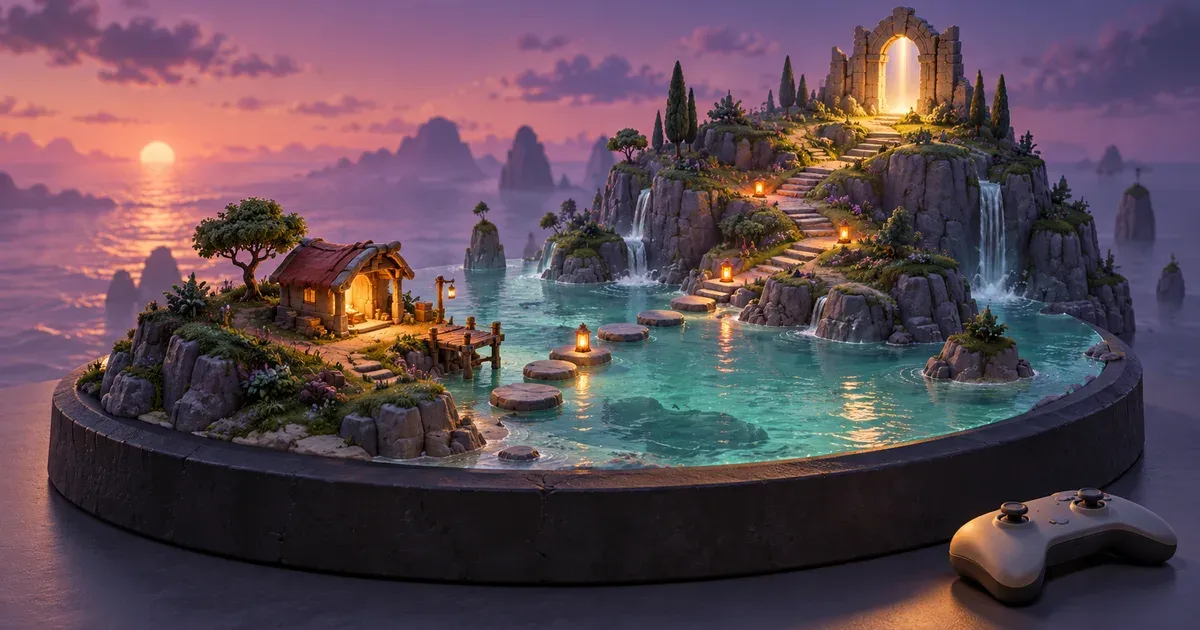
Stepping stones over water and a light suggesting a distant passage. An illustrative game scene generated with AI for SeTRoX, not a Rivunox screenshot.
Discovery is different from a long feature list
Discovering something need not mean unlocking another region. Finding a different use for a familiar move, noticing a shorter connection between known places or understanding a rhythm that previously escaped you can all be discoveries. None of those necessarily requires another feature. A carefully arranged situation can let a player approach an existing ability from an unfamiliar angle.
In an imagined level, a moving platform that was initially only crossed might later become a way to reach a different passage. The player reinterprets something they already know rather than memorising another button. Whether that arrangement works cannot be settled by a design document alone. Watching what a player actually notices may reveal more than explaining what the designer intended them to notice. The gap between intention and observation is often where the useful next change becomes visible.
Rhythm is more than speed
Discussion of a game's rhythm can quickly turn to faster music or larger enemy groups. Rhythm also lives in transitions between concentration and relief. Encountering an idea, trying it in a forgiving situation and using it under a changed condition are three different moments. If all arrive at once and under the same pressure, it becomes difficult to see what the player has understood.
Even a short game can make room for small intervals: a moment to read a situation, a clear result at the end of a round or a calm choice before another attempt. That does not require adding lengthy waiting screens. It means looking for a pace in which actions and consequences can be connected. A similar question appears in what remains after a film: sound, colour and rhythm. Is an experience shaped only by what happens, or also by the distance between its events?
Difficulty options can protect an experience's intention
A difficult obstacle does not give every player the same experience. Timing, visual interpretation, navigation and remembering information make different demands. Someone comfortable with one may need support with another. Microsoft's Xbox guidance on game difficulty options discusses providing options for different abilities and barriers. The useful question is which difficulty belongs to the experience's purpose and which barrier unnecessarily prevents a player from reaching it.
A meaningful attempt does not always require every person to act within the same interval or with identical precision. Assistance can sometimes be separated into adjustable parts, such as hint frequency, time pressure or support for a particular action. Those are possibilities to assess, not features promised for a specific project here. Begin by describing the intended experience, then examine how different players can reach it without assuming that one fixed arrangement works equally well for everyone.
A returning player should not need a perfect memory
After a few days away, it is easy to forget a control or the last objective. That return can matter as much as the opening screen. A short reminder, a reviewable objective or a safe place to try a move again can help a player re-establish their relationship with the game without repeating a complete introduction. Returning does not have to feel like taking an exam on the previous session.
Microsoft's guideline on objective clarity addresses reviewing current goals and progress. My design question is this: can the game tell a returning player where they left off? Unless testing recall is a deliberate purpose of the game, avoidable memory demands should not stand in the way of discovery. The answer need not be a permanently crowded dashboard. Information available when it is wanted may be more appropriate to the particular experience.

A quiet stopping point with a bench and two paths in an imagined game world. An illustrative game scene generated with AI for SeTRoX, not a Rivunox screenshot.
Ask one clear question of a prototype
Improving an experience may begin with observation rather than another feature. Choose one question for a prototype: is the first action understood, is a clue noticed, or is the reason for failure readable? These questions connect to each other, but trying to solve all of them simultaneously makes it harder to tell which change helped. Observe the current behaviour, make a small change and look again before expanding the scope.
Instead of immediately explaining the level, watch where someone stops, looks and experiments. Afterwards, add a concrete question alongside the broad “was it fun?”: when you decided to try again, what did you want to do differently? This is a suggestion for a useful prototype conversation, not a claimed research result or universal measurement method. It is the game-design counterpart of the small-step approach in where an idea begins.
A good stopping point is part of returning
Finishing a round, stepping away and coming back need not oppose each other. Knowing where to stop, understanding what progress means and leaving without an unnecessary penalty can contribute to trust in the experience. A game can invite another visit by remaining understandable and worthwhile, rather than relying on an endless reminder that something will be lost if the player looks away.
The Rivunox project page connects these thoughts to the game work we develop together. The imagined island, platforms and passages in this essay are not claims about Rivunox's current features or screenshots. They are invented scenes that make a question easier to consider: when a player wants one more round, what are they hoping to discover again? Sometimes the answer is not a larger world, but another possibility inside an already familiar action.
Let’s leave a thought here.
Sometimes the next step is to pause and look again.